

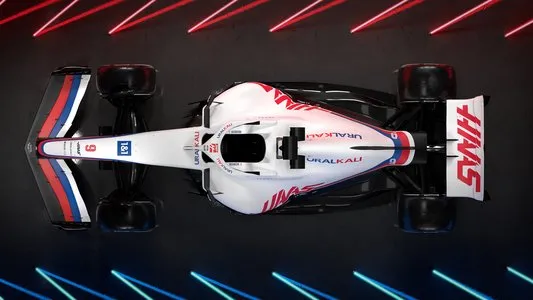
New is the keyword for the 2022 season that lies ahead, in which a fresh set of regulations will come to life through the new car’s design and then be reflected on track, as the main goal is to promote closer racing among all teams across a record of 23 Grand Prix.
Gene Haas, Founder of Haas Automation and Chairman of Uralkali Haas F1 Team, said: “We made the decision back in 2020 to really channel time and resources into the VF-22, foregoing anything track-related for 2021 - which wasn’t easy to watch. Hopefully, that decision bears fruit, and we return to challenging for points and taking something from the weekends.”
Behind the wheel of the VF-22 challenger will be Mick Schumacher and Nikita Mazepin, with both drivers beginning their second season at the pinnacle of motorsport with the Uralkali Haas F1 Team. Pietro Fittipaldi will continue in his Test and Reserve Driver role.
Furthermore, the American squad is about to start its seventh season in Formula One with renovated hopes and a brand new structure, a design office in Maranello, Italy, led by Technical Director Simone Resta.
Speaking about the challenges imposed by the new regulations, Resta explained: “This is probably the most complex project the Uralkali Haas F1 Team has dealt with to date for many reasons.
“It’s a completely new set of regulations, and this season we’ve brought in a new team to manage the creation of the VF-22. Not everyone is new, but a good chunk of people have joined with a revised structure now in place. I consider this as a great success in the process. We’re still early in the project and going through a transitional season of working together on a car for a full year, but if we look back where we started, this team is already a success.”
Having a much closer midfield aims for more action on track. And if 2021 was one of the most competitive Formula One seasons in recent years, it also made it clear the mid-field teams had few opportunities to battle for top 10 positions, podiums, or even points.
2022 however, promises to shake the grid. The development of some areas of the car is restricted. On top of that, the aerodynamics package will be responsible for much of the change generated.
TECHNICAL SHEET
According to Haas F1 Team, the aerodynamics of the VF-22 will be completely different from anything previously seen as new items have been incorporated to achieve the goal of the regulations, such as a ground-effect floor, simplified front-wing, and a dramatic shaped rear-wing.
The new regulations go beyond the car, comprising the tires following a switch from the 13-inch tires to the new 18-inch wheels.
Pirelli, Formula 1 Global Tire Partner since 2011, was in charge of developing a new product, from the design of the virtual model to the construction of the physical compounds.
The process led to redesigning the profile completely, hitting the track by the end of 2019 for the first testing. Since those early days, Pirelli’s 18-inch tires have come a long way.
Mario Isola, Pirelli Head of F1 and Car Racing, stressed in our latest interview: “Our main target is to have less overheating and a wider working range, which should help the drivers to be able to push on tires from the start to the end of the stint. “
You can read the full interview by clicking here.
Furthermore, the VF-22 will be powered by the Ferrari 066/7 turbocharged 1.6-liter V6 power-unit running on fuel containing a 10% bio-component ratio achieved through a move to E10 fuel.
Guenther Steiner, Team Principal - Uralkali Haas F1 Team commented: “It’s exciting to be at the point where we know the VF-22 will be on track shortly. “It’s been a tremendous effort by everyone involved and, now comes the fun part of getting the new car to the circuit and dialing in all the elements.
“Last season was a long one, but I’m confident that 2022 will see us back in the mix with the VF-22.”
A pre-season session shakedown will run in Barcelona, Spain, at the Circuit de Barcelona-Catalunya from February 23-25.
From March 10-12, official pre-season testing will take place in Sakhir, Bahrain, at the International Circuit ahead of the season opener, the Bahrain Grand Prix, set to run from March 18-20.