
Miroslav Klose
User Rating
Your Rating
| Position | Forward |
| Height / weight | 1.84 m / 74 kg |
| Born | 9 Jun 1978 (48 years) |
| Nationality |  Germany Germany |
| Nickname | Miro |
| Number | 11 |
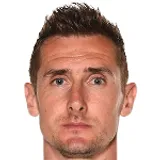
Born in Poland, to a mother who was a part of the Women’s National Handball Team and a father who played professional football, Miroslav Josef Klose grew up to become a professional footballer. Calling himself European, rather than German or Polish, Klose chose to represent Germany at the national level.
Klose began his playing career in the tiny village team of SG Blaubach-Diedelkopf, in 1987. For 11 years, Klose honed his skills at this small club, before trying out for various club teams in the lower divisions. He got an opportunity to play at FC Homburg, a club based in Saarland.
In just 20 games for FC Homburg, Klose scored 11 goals and gained the approval of many big clubs, including 1. FC Kaiserslautern. In 1999, FC Kaiserslautern signed him up and put him in their B-team. Klose spent two seasons with the B-team, honing his skills and scoring 26 goals from 50 games. Kaiserslautern had seen enough of the youngster and decided that he was good enough to be in the first team squad.
Although Klose was hopping between the B-team and the first team squad, it wasn’t until 2001 that he actually became a regular member of the first team. 44 goals in 120 appearances had put him amongst the top strikers in Germany, however, it was his performance at the 2002 FIFA World Cup that made all the difference.
Klose scored five goals to become the second-highest scorer at the 2002 World Cup. All five of his goals came from headers. After playing at Kaiserslautern until 2004, Klose moved to Werder Bremen where he truly came into his own. At Bremen, Klose’s scoring skills really came to the fore as formed a lethal strike-force with Johan Micoud and Ivan Klasnic.
In his first season with Bremen, Klose scored 25 goals in 26 games, a fantastic record! Over the next two seasons, Klose would play 89 games for the side, scoring 53 goals in that period.
In 2007, he was signed by Bayern Munich who were looking to rebuild after their squad had gone into decline.
Suffering from numerous injury and fitness issues, Klose’s time at Bayern has not been the best it could be. Despite that, he has played 91 games over 4 seasons, scoring 24 goals. Most of Klose appearances, under coach Louis Van Gaal, had been as a substitute, leading to a lower goal tally than before. However, Klose did win the 2007-08 and 2009-10 Bundesliga title.
He also has the 2008 and 2010 DFB-Pokal title as well as the 2007 Ligapokal winner’s medal and the 2010 DFB-Supercup winner’s medal with Bayern Munich. Klose also won the DFB-Ligapokal title with Werder Bremen, in 2006.
At the international level, Klose has been far more successful, winning the FIFA World Cup runner’s up medal in 2002, the third-place medal in 2006 and 2010 as well as the UEFA European Champions’ runners up medal in 2008.
He has been the top scorer in the Bundesliga in 2006 and was also named the German Footballer of the Year in the same year. Klose has a Silver Shoe for being the second highest goalscorer at the 2002 FIFA World Cup while his 2006 adventure won him the Golden Shoe.
Klose has 61 goals for the German senior national team in just under 110 games. He is the FIFA World Cup’s second highest top-scorer of all time, tied at 14 goals with German legend Gerd Muller. He is also Germany’s second highest international goal scorer of all time, with 61 goals. With 5 goals in 2002, 5 in 2006 and 4 in 2010, Klose holds the record of scoring the most number of coals in consecutive World Cups.