

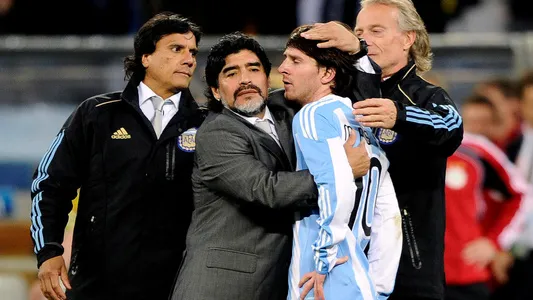
Two weeks ago, he had been rushed to hospital with a bleed on the brain. He successfully came through that, and returned home, where he was preparing to resume treatment for alcohol dependency. However, he then had a heart attack and passed away.
Maradona’s life was dogged by controversy on and off the field. For all his undoubted talent, many in England have never forgiven him for his “Hand of God” goal in the 986 World Cup, when he tipped the ball into the net with his hand.
He was a legend at Napoli who he helped win the league title for the first time in their history, but towards the end of his time there, became embroiled with the local mafia, the Camorra, and became addicted to cocaine.
In 1991 he was banned from football for 15 months after failing a drugs test and was thrown out of the 1994 World Cup after testing positive for the banned substance ephedrine.
He also developed a dependency on alcohol, whilst post retirement his weight ballooned to 20 stone before he had a gastric band fitted.
Yet despite all his faults, he could do on a football field what few men before or after him could manage. Although only 5 foot 5 inches tall, and stockily built, he was an excellent dribbler and passer of the ball, with supreme vision and technique. Maradona could beat three or four players on his own, and then either score or lay the ball off for others to finish the move.
In that 1986 World Cup he captained Argentina to final glory, scoring both goals in both the quarterfinals and semi-finals. And, if his first goal against England in that tournament showed the darker side of his character, his second showcased his talents for the world to see. Running from his own half, he left six England defenders for dead before sliding the ball past goalkeeper Peter Shilton.
The term legend is overused in sport but, in the case of Diego Maradona, it is fully merited.