

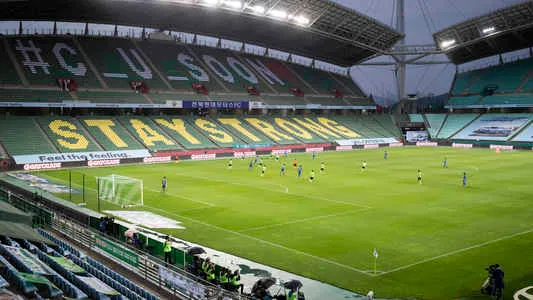
Having originally been scheduled to start in February but was delayed because of the coronavirus pandemic, the K-League finally began on Friday night with a match between the defending champions Jeonbuk Motors, and the cup holders Suwon Bluewings.
But in a stadium that normally holds over 42,000 spectators, the gates were locked and only a handful of people were allowed in, all of whom had to wear masks, including the watching South Korean team manager. All the substitutes and team officials also wore masks, as did the fourth official.
The players themselves did not wear masks, but were banned from spitting, and had to maintain social distancing rules when talking to each other, and there was no customary handshakes between the two teams at the end of the game. Instead the players bumped fists with each other.
For the most part the game was played in an eerie silence, interspersed with the cries of the players, although, in an attempt to generate some atmosphere, artificial crowd noises were piped in from time to time over the stadium loudspeakers.
Despite this, the game was watched by millions of people, not just in South Korea but around the world. Both clubs suddenly acquired new armies of fans globally amongst people who, until a week ago, had probably never even heard of the K-League.
That was after the decision by many European and other foreign broadcasters to acquire the live rights to the game knowing that there was a legion of armchair fans desperate to watch some live football again.
In the end, the game was won by Jeonbuk Motors with a header from substitute Lee Dong-gook, six minutes from time.
For most of the viewers though, apart from the fans of both sides, the result itself was irrelevant. What mattered was that football was back although quite not how people remembered it.