

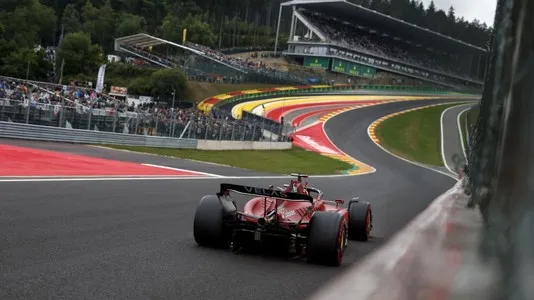
All six manufacturers will supply the new power units, as established by Formula One 2026 Power Unit Technical, Sporting, and Financial Regulations approved last August by the FIA World Motor Sport Council.
In that regard, the new rules start a new chapter at the pinnacle of motorsport, aiming to achieve the goal of becoming a carbon-neutral racing series by 2030.
The companies confirmed are Alpine Racing, Audi, Ferrari S.p.A., Honda Racing Corporation, Mercedes-AMG High-Performance Powertrains Ltd, and Red Bull Ford.
FIA President Mohammed Ben Sulayem stated: “The confirmation that there will be six Power Unit manufacturers competing in Formula 1 from 2026 is a testament to the strength of the championship and the robust technical regulations that have been diligently created by the FIA, in close collaboration with Formula 1 and the Power Unit manufacturers.”
“The Power Unit is at the forefront of technological innovation, making the future of Formula 1 more sustainable while maintaining spectacular racing. I am grateful for the confidence of world-leading automotive manufacturers demonstrated by their commitment to Formula 1.”
The next-gen hybrid power unit will use cutting-edge technology to increase the power unit’s electric share by up to 50 percent, using 100 percent of advanced sustainable synthetic fuel.
Greater electrification translates into a more environmentally sustainable racing platform, using high-revving V6 internal combustion engines and avoiding excessive performance differentiation to allow for improved raceability.
On the way to innovation, becoming a cost-effective platform has been essential to attract newcomers to join the sport at a competitive level.
Such is the case of Audi, which has set its entry to Formula One for 2026 as Sauber’s works team and Ford.
Last Friday in New York, the American giant announced its return to the series after nearly two decades away by signing a technical partnership with Red Bull Powertrains, providing the power units for Oracle Red Bull Racing and Scuderia AlphaTauri teams from 2026 to at least 2030.
Following the official announcement, Stefano Domenicali, President and CEO of F1, said: “The news today that Ford is coming to Formula 1 from 2026 is great for the sport, and we are excited to see them join the incredible automotive partners already in Formula 1.”
“Our commitment to be Net Zero Carbon by 2030 and to introduce sustainable fuels in the F1 cars from 2026 is also an important reason for their decision to enter F1,” he remarked.
The financial sustainability emphasis is to reduce the overall costs for competitors while retaining the cutting-edge technology showcase at the core of the series.
Into effect from early January, the FIA has established a cost cap level of 95 USD MM for the Reporting Periods of 2022-2025 and 130 USD MM from 2026 onwards.
Technical PU Regulations Highlights
According to the FIA, the Internal Combustion Engine (ICE) will maintain the V6, 1.6-liter layout at the same RPM, with a reduced fuel flow rate, to aim for a power output of approximately 400kW. And it will be broadly split into two parts, the lower and upper parts.
The goal is for ICE competition to focus primarily on the upper part, with the lower part being more prescribed dimensionally and having more extensive homologation periods.
In addition, the MGUH will be removed, helping achieve cost reduction.
Furthermore, the Energy Recovery System (ERS) will increase power to 350kW. An area that will challenge PU suppliers, as the focus will be on energy flow management to reach the main objectives of spectacle, increased hybridization, and similar overall performance to the current PU.
Last but not least, fully sustainable fuel is fundamental to the 2026 regulations. All fuel components must come from sustainable sources to guarantee that no new fossil carbon will be in the fuels used in the series.
No new fossil carbon will enter the atmosphere from a Formula 1 car exhaust.
Moreover, road cars will be able to use the same sustainable fuel as well.