

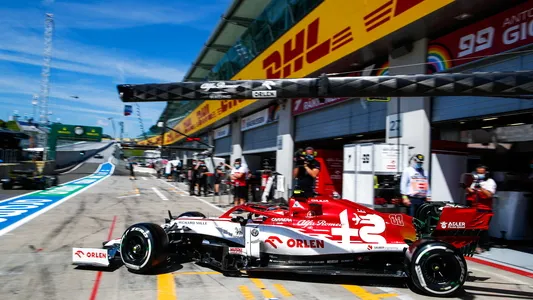
Native from Krakow, the second-largest city in Poland - a country of central Europe that boasts a striking beauty and passion for sports,35-year-old Robert Kubica discovered at an early age, his love for motorsport.
I am one of those who believe all of us are born with a gift, whether one recognizes and explores it, that is another story.
His journey began in karting, yet unaware he was a natural behind the wheel.
Junior formulae followed, and then an official reserve driver role with BMW Sauber in F1.
He won races, championships, he did everything to achieve the pinnacle of motorsport, and in 2006 when the opportunity presented itself, he did not hesitate.
Twenty-one-year-old Kubica became the first Polish driver to contest the FIA Formula One World Championship.
The land where the second oldest rally in the world (Rally Poland) takes place, - preceded only by Rally of Monte Carlo, soon embraced with fervency the talent and determination of its prodigy son.
ROBERT KUBICA: THE INTERVIEW
In 2020, the Pole is combining a Formula One role - as Alfa Romeo Racing ORLEN F1 Team reserve driver, and a DTM race seat with BMW ORLEN Team in a single-car entry operated by ART Grand Prix.
Both series have struggled to resume as well as other motorsport series due to the COVID-19 pandemic.
SP: Your mind and body have been challenged deeply throughout your career.How that experience served you to deal physically and mentally with the unprecedented times presented due to the Covid-19 pandemic?
RK: “I am not someone to let things that happen get me down. You just have to face what life gives you with your strength and try to make the best of the situation. In the end, with the current Covid-19 situation, we have to consider that the inconvenience of the lockdown is nothing compared to what some people had to endure.”
SP: From your perspective, how much the car weighs in the fate of the driver in the current F1 championship?
RK: “Formula One is a team sport and, of course, the role of the car is hugely important. The driver still plays a huge part, not only on track but also in the development of the car.”
SP: Do you believe the changes in the regulations comprising key areas such as the Cost Cap level, limit downforce on next year’s cars, among others, could effectively help to close the gap on the front of the grid?
RK: “Having a closer grid, with the gap in performance between teams smaller, would definitely make the contribution of the driver bigger, but in the end, it is nothing in my power we just drive the car to the best of our ability.”
SP: In which aspects do you feel your driving evolved the most after your comeback to the Formula One grid last year?
RK: “A lot of things have changed since 2010, both in the way I drive and in the way the cars are. The basics are the same, but there is something to learn every time you are in the car in any car so I think my driving evolved with it.”
On the 2020 season of the DTM championship - that got underway this weekend at Spa-Francorchamps, Kubica said: “DTM is a hugely competitive championship and those cars are extremely powerful.
There are drivers who have competed in the series for years and have a lot of experience, which is an aspect on which I need to make up some ground. Its hard to tell where we will be once the season starts but I am fully expecting to be as competitive as I can be.”
On August 1st, his debut campaign in DTM began with two 14th places in a doubleheader event dominated by the Audi Sport Team.
Another talking point was his assessment on his team - Alfa Romeo Racing ORLEN F1, performance after the first three races of a compact 2020 Formula One season.
RK: “Of course, we are not yet where we would like to be. We managed to score two points with Antonio in Austria, but we have been outside the top 10 in the other two events.
The season is still long and the team is already introducing upgrades, so we can hope to claw back some ground and get back to fighting for the points in every race.”
The Pole drove the C39 during the first free practice session of the Styrian Grand Prix and then again in Hungary at Hungaroring, the circuit where he made his Grand Prix debut with BMW Sauber in 2006.
The Anecdotes From The Tunnel of Time
In 2005, Kubica contested the World Series by Renault with Spanish team Epsilon Euskadi, claiming the title in his debut season, securing a test drive with Renault F1.
Sports Pundit sat down with Nicolas Etchamendi, an Uruguayan mechanic who worked on the Pole car that year to learn more about the season that would prompt Kubica to Formula 1.
NE: “It was a Spanish team with a Spanish number one driver [Felix Porteiro], and Robert Kubica as number two. I was assigned to work on Robert’s car, alongside an Argentinian mechanic.”
SP: What surprised you the most in your time working with Robert Kubica?
NE: “He was extremely fast from the get-go, quickly adapting to the car.
At that time, he was coming from Formula 3, in his first training session, he set the fastest time ahead of his teammate.”
“When he complained about anything related to the setup of the car, you knew there was a point to it.
I remember that one time when we were running in the wet, he complained about the lack of traction, and when we went on to checked, the setup of the rear wing was wrong,” he recalls.
“He has this great ability to develop cars and make them fast, which is a fantastic asset to any team. That year we won races and the championship.”
Etchamendi moved on to GP2 the next year, working for Campos Team, while the Pole joined the BMW Sauber F1 Team as an official test driver - taking part in free practice sessions that often saw him at the top of the timesheets.
Ahead of the 2006 Grand Prix in Hungary official driver, and 1997 Formula One World Champion Jacques Villeneuve, was reported to suffer headaches from a previous accident at the German Grand Prix, which ruled him out to race at Hungaroring, having Kubica to replace the Canadian.
Etchamendi and Kubica paths would then cross again, on his own words, he recollects the weekend that marked the driver debut in Formula One.
“I was in the circuit working with the GP2 Campos team that year, and it was great to see Robert in Formula 1.
We had lunch Thursday or Friday, I asked my dad to sent over the official t-shirt of the Uruguayan Soccer Team, to give it to him as a gift, to wish him luck that weekend.
Hungaroring is a demanding circuit that delivers exceptional races. I believe he (Kubica) could have won that day.”
“Robert is one of the few drivers to have won on their debut race, whatever is the series he was racing in,” he adds.
A STAR RISES IN FORMULA 1
After Hungary, Kubica became a teammate to Nick Heidfeld for the remainder of the season and would continue as a full-time driver with BMW Sauber until the end of 2009.
In 2008 he took his first and only Grand Prix victory at the Canadian Grand Prix, setting the team maiden victory in Formula One.
Overall, he conquered nine podiums with the team throughout the years they worked together.
In 2010, he signed for the Renault F1 team to pair Russian driver Vitaly Petrov.
His skill set made him visit the podium on three occasions with the French team, and at iconic race tracks like Monaco, Spa-Francorchamps, Melbourne.
That same year he finished eighth in the overall standings.
In 2011 the team was renamed Lotus Renault GP, and at pre-season testing in Valencia early in January, Kubica placed the R31at the top of the charts, the season ahead was promising.
STARTING LIFE FROM ZERO
In February 2011, a life-changing accident at the Ronde di Andora Rally seemed to lead his rising career to a premature end; the lights went off, curtains closed, the circus had to move on without him.
Despite the pain, the surgeries, the uncertainties, Kubica’s mindset focused on one direction only, rehabilitation; giving up was never an option, to adapt, was a challenge he was ready to face.
Talent is key to a racing driver, but while climbing the ladder towards a dream, they need to learn how to be strong mentally and physically as their minds and bodies are put the ultimate test behind the wheel of a Formula One car.
In some cases, the driver shows a natural mindset, somehow ideal to the profession he has chosen to follow.
“This is Roberts advantage. Its not about physical tests or how many kilos he can move. Its about the package and hes just a lucky person. Its a package created to be a driver. People who are three years old, they are already top musicians.
For motorsport, Robert is like this. He is someone born to do this. He is extremely strong by nature, said Dr. Riccardo Ceccarelli head of Formula Medicine in an interview with Formula 1 official media website.
From 2012 to 2016, Kubica returned to rally racing, and as time went by, it became clear that things have changed, but despite the limitations caused by the injuries sustained in his right forearm, the speed was still there, and the Pole had unfinished business to attend.
AGAINST ALL OF THE ODDS
August 1st also marked the forty-four anniversary of the day the motorsport world stood still, watching three-time Formula One World Champion Niki Lauda near-fatal accident at Nurburgring.
The Austrian crash in 1976 makes you doubt your own eyes in a flash of a second, safety at the time was far away from what it is today, and such a terrifying accident was synonymous to death.
One, if not the greatest comeback in Formula One history, allowed us to know the story of a driver turned into a legend.
Lauda never gave up attitude, showed the tenacious fight for the life of a man of extraordinary willpower and resilience, even when some were beginning to talk about him in the past tense.
Six weeks, after being dragged from his burning Ferrari 312T, the Austrian driver was back in the car at the Monza Grand Prix, the rest is history.
For Kubica, it would not take six weeks or even months; instead, six long years will go by before he could have the chance to step into a Formula One car again.
A comeback though to a full-time race seat was many times addressed as unlikely, impossible, would he prove them wrong?
The fans never lost an adamant hope of seeing the Pole driver behind the wheel of a Formula One car again.
A sunny day of June 2017, a door opens, its the first step, that day Kubica would find answers to the only questions that mattered, those of his own.
In a test organized by the Renault F1 Team, he drove the 2012 Lotus E20 in Valencia, Spain, at the Circuit Ricardo Tormo.
Official video: Testing at Valencia
The proof of fire for the 32-year-old would come later in August when the French team announced the Pole would take part in the official post-Hungary Grand Prix testing, driving the Renault RS17 in Hungaroring.
He clocked up 142 laps, finishing fourth-fastest in a session dominated by the Ferrari of four-time Formula One World Champion Sebastian Vettel.
BOUNCING BACK
A test programme with a 2017 spec car with Williams followed, he then joined the team of Grove as a development driver for the upcoming season.In 2019, the moment all his fans have been waiting for, Kubica was back to Formula One as a full-time driver signed by Williams Racing to partner 2018 FIA Formula 2 Champion George Russell.
After eight years out of the sports elite, his comeback was not miraculous, on the contrary.
The achievement is written in Formula One history books, but there are no fairy tales in motorsport.
To be in the right place at the right time can make all the difference when there are only 20 seats on the whole grid.
In 2019 Williams struggled all season, the FW42 presented technical challenges, both cars were far off the pace since the first race of the season, being the slowest in the grid became a constant during that year.
The British team earned one point in the entire season, a point scored by Robert Kubica at Hockenheim, Germany, as he finished in tenth place at the Grand Prix.
At the age of 35, Kubica is probably in the best physical shape of his career as his journey in Formula One continues, this season from his reserve driver role with Alfa Romeo ORLEN Racing.
“A driver with his experience always comes up with valuable feedback and he will be able to help us continue learning about our car,” said Frederic Vasseur, Team Principal Alfa Romeo Racing ORLEN and CEO Sauber Motorsport AG.
We referred our last question to Nicolas Etchamendi to learn about his assessment of Robert Kubica’s work with the Hinwil team so far.
“His limitations are a reality, but at that level of competition, nobody gives you nothing for free.
As I said before, he is an asset to any team when it comes to developing the cars,” he remarked.
“The man with a new idea is a crank until the idea succeeds,” Mark Twain.