
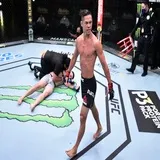
In most full-contact combat sports, whether it be boxing, fighting-based video games, or mixed martial arts, a KO or a knockout ends a fight. It is a clear-cut winning criterion in every match. Unlike boxing, mixed martial arts (MMA) does not require a time count after a knockdown. In many MMA sports, the fighters compete not on their feet but mostly grappling on the mat. Competitors win a match through dominance and by forcing the other fighter to submit and give up.
How to Establish Knockdowns?
Many MMA fights end with a knockdown after one of the competitors successfully lands a series of hard blows, and the defensive fighter is cornered or is unable to fight back effectively. When combatants are grappling with each other, one of them can deliver a knock-out by using a combination of attacks: a slam, a suplex, and/or a pound.An example of a match that ends after a few minutes is when the aggressive fighter delivers a lower left kick to his opponent and quickly followed it with a right punch that landed just below his opponent's left jaw. In a defensive attempt, the opponent circled away, trying to avoid the linear forward battle-movement of the aggressive competitor. But the aggressive player caught up with him and jumped. One of his knees landed on the opponent's solar plexus. The fight swiftly ended when the aggressive fighter grabbed the opponent's head and slammed it on his knee. The dazed opponent fell on the fall, practically losing consciousness resulting in declaring the aggressive fighter as the winner by knockout.
How Knockouts are Declared?
Based on rules, a knockout is declared when the fighter loses consciousness due to any legal strike or a combination of strikes. A KO is achieved even if it happens for a brief moment only, and even if the fighter regains consciousness to continue to fight.A knockout is also declared when a competitor sustains a hard hit and is unable to retaliate immediately. A referee may also declare a technical knockout (TKO) if he sees a fighter unable to intelligently defend himself from being repeatedly struck by its opponent.